Every Tuesday afternoon we publish a collection of topics and give our expert opinion about the Equity Markets.
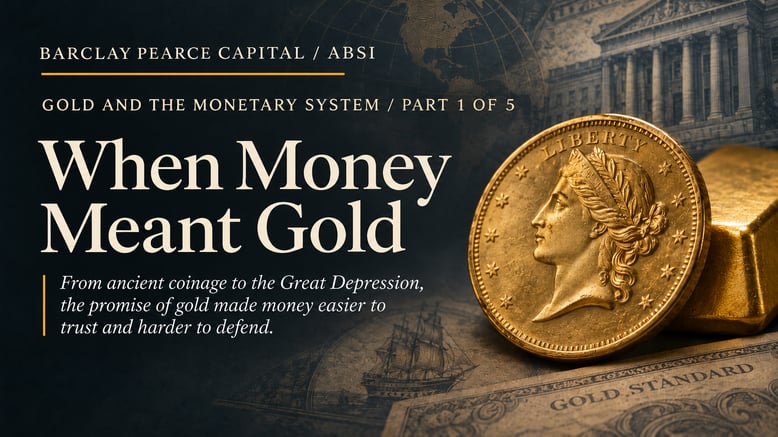
BARCLAY PEARCE CAPITAL / ABSI
GOLD AND THE MONETARY SYSTEM / PART 1 OF 3
When Money Meant Gold
From ancient coinage to the Great Depression, the promise of gold made money easier to trust and harder to defend.
In 1925, Britain restored the pound’s link to gold at its pre-war rate. Six years later, it abandoned that commitment. In between lay a question that had taken centuries to come into focus: what happens when the price a government has promised to defend no longer suits the economy it governs?
The story begins with a simpler problem: a piece of precious metal could carry a great deal of value, but its weight and purity had to be established before it changed hands. In ancient Lydia, in what is now Türkiye, some of the earliest coins were struck from electrum, a naturally occurring alloy of gold and silver. Later issues used the metals separately. An official stamp gave traders a denomination they could recognise, sparing them some of the work of weighing and testing the metal for themselves.
The next leap came when people could carry paper and leave the gold where it was. A note could pass from buyer to seller because the holder believed it could be exchanged for a fixed amount of metal. By the late nineteenth century, a number of major economies had made that promise. Once two countries fixed their currencies to the same metal, they effectively fixed the exchange rate between them. A merchant could agree a price with an overseas supplier with much less uncertainty about the eventual cost.
That certainty had a price: when gold began leaving a country, the authorities could raise interest rates to attract capital and protect their reserves. The same move made borrowing dearer for households and businesses. If people feared a suspension, they had every reason to ask for their gold while they still could. A promise intended to keep people confident could make a rush for the exits more urgent.
The Trade-Off Between Stability and Flexibility
While the gold standard constrained governments' ability to respond to economic shocks, that constraint was also one of its greatest strengths. By limiting discretionary monetary expansion, gold imposed a degree of discipline on governments and central banks, supporting confidence in the currency.
Removing that external constraint gave policymakers greater flexibility, but also placed more responsibility on central bank independence, credible institutions and sound fiscal management. The question became whether governments could maintain that discipline themselves, particularly during periods of economic stress.
Was the Gold Standard Really to Blame?
The First World War disrupted the system. Britain’s return in 1925 tried to restore an exchange rate set before the war had changed the economy. By 1931, with the Depression deepening and pressure on sterling mounting, Britain let the gold link go.
Britain's abandonment of gold in 1931 was not necessarily a failure of the gold standard itself. The decision to restore sterling at its pre-war exchange rate in 1925 arguably left the pound overvalued relative to Britain's post-war economic position.
The resulting pressure on wages, employment and competitiveness was therefore partly a consequence of that policy decision, rather than an unavoidable consequence of gold convertibility. The distinction matters: was the system fundamentally flawed, or was it being defended at an unsustainable exchange rate?
Across the Atlantic, Franklin Roosevelt’s administration ended ordinary domestic redemption in 1933. The following year, the US Treasury took ownership of the Federal Reserve’s monetary gold, and the official price rose from US$20.67 to US$35 a troy ounce. Each dollar now bought less gold.
The old promise returned in a narrower form at Bretton Woods in 1944. Other currencies generally fixed their rates against the dollar, and foreign monetary authorities could exchange eligible dollar holdings for US gold at US$35 an ounce. A commitment once available to ordinary holders of paper money had become an arrangement between monetary authorities.
From Gold-Backed Money to Institutional Trust
The transition from gold-backed money to fiat currencies did not eliminate monetary risk; it changed its nature.
Under the gold standard, the challenge was maintaining convertibility during periods of economic stress. Under modern monetary systems, the challenge is preserving purchasing power without the same physical constraint on money creation.
Monetary flexibility can help governments and central banks respond to economic shocks. However, without credible institutions and disciplined policy, that flexibility can also contribute to inflation and currency depreciation. Confidence in money ultimately depends on the institutions responsible for maintaining its value.
The world moved away from the gold standard decades ago, yet gold remains one of the most closely followed assets in global financial markets. Why?
Michael Bogoevski and Angelica Mehmet sit down to discuss this further, including the trade-off between monetary discipline and economic flexibility, why central banks continue to accumulate gold, and what its monetary history tells us about investor sentiment today. Watch the full discussion below:
What It Means for Australian Investors
Today, an Australian investor buying bullion takes a view on two market prices. If gold holds steady in US dollars and the Australian dollar weakens, the local price of gold rises. A shareholder in a gold producer has a further set of moving parts, including the mine’s output, costs and hedging.
The gold price may be quoted as a single figure on the market page. The return an Australian investor earns can tell a different story.
General market commentary only. This document does not consider any investor’s objectives, financial situation or needs and contains no individual security recommendation. Forward looking assessments are conditional and may change. Investors should assess suitability and seek advice where appropriate.
We offer value-rich content to our BPC community of subscribers. If you're interested in the stock market, you will enjoy our exclusive mailing lists focused on all aspects of the market.
To receive our exclusive E-Newsletter, subscribe to 'As Barclay Sees It' now.